Additional Therapies
Reflex Integration Therapy
Reflexes are essential for survival and serve a protective and developmental function. When we first come into the world, we move in reflexive movement patterns. As we grow, we develop more refined movement patterns. Our reflexes integrate. They help us get to that next developmental level.
Reflexes are very important to us. We initially need these reflexes. They help us develop physically, cognitively, and emotionally. They are there for that part of our development and then they go away.
Some children retain these reflexes. They have not gone away. The retention of primitive reflexes can impair a child’s ability to progress in various areas of development. By helping a child to integrate some of these primitive reflexes, we can help child grow.

The Importance of Crawling
Crawling is very important for children, but why is that? There are many reasons why crawling is important for our development: we push up from the ground and development shoulder stability which is important for fine motor skills. We develop greater core strength during this time. We also integrate various primitive reflexes during the crawling stage. The integration of these reflexes lead to important development later on. For example, Symmetrical Tonic Neck Reflex or STNR begins to integrate during the stage. The child will rock on all fours. They will look at objects far away and near while crawling. These early skills and the integration of STNR relates to later skills such as copying from the board in school or challenges with depth perception
Let’s take a look a little further at one of our reflexes!
The Babinski Reflex

What is it?
The babinski reflex is activated with touch input to certain areas of the foot. You will see the big toe rise up while the other toes will fan out and down.
How does it help us develop?
Supports crawling and prepares the infant to stand. Important for balance and gross motor skills
When does it go away?
Typically, you will see this reflex integrate (or go away) between the first and second year of life.
Why should we integrate the reflex?
A retained babinski reflex can lead to difficulties with sense of grounding and stability, poor balance, poor bilateral integration, gross motor coordination, and timidity
How do we integrate the babinski reflex?
Specifics to be discussed with a therapist trained in reflex integration. Exercises may involve various passive movement of the foot into the reflex along with more active exercises such as walking on the sides of your feet.
Content on the Babinski Reflex was taken from Masgutova Neurosensorimotor Reflex Integrative group with permission. More information from MNRI can be found at their website: https://masgutovamethod.com
Sound-Based Therapies
Sound is an important part of how we experience the world. It helps us connect with others, make sense of our surroundings, and participate in everyday activities. For some children, listening and responding to sounds can be challenging.
How important is it to analyze sound efficiently?
Consider the space you are in now. You are able to tell the spatial relationships of people and objects in your environment by the sounds you hear. Understanding the spatial relationships of people and objects around you is important for you to feel safe and secure. You are probably not paying attention to many of the sounds around you. The air conditioner or heater may have clicked on, but you have habituated to that sound are no longer attending to it. Some children are challenged with these skills. Knowing what to listen to in your environment is essential for attention, learning, and communication.
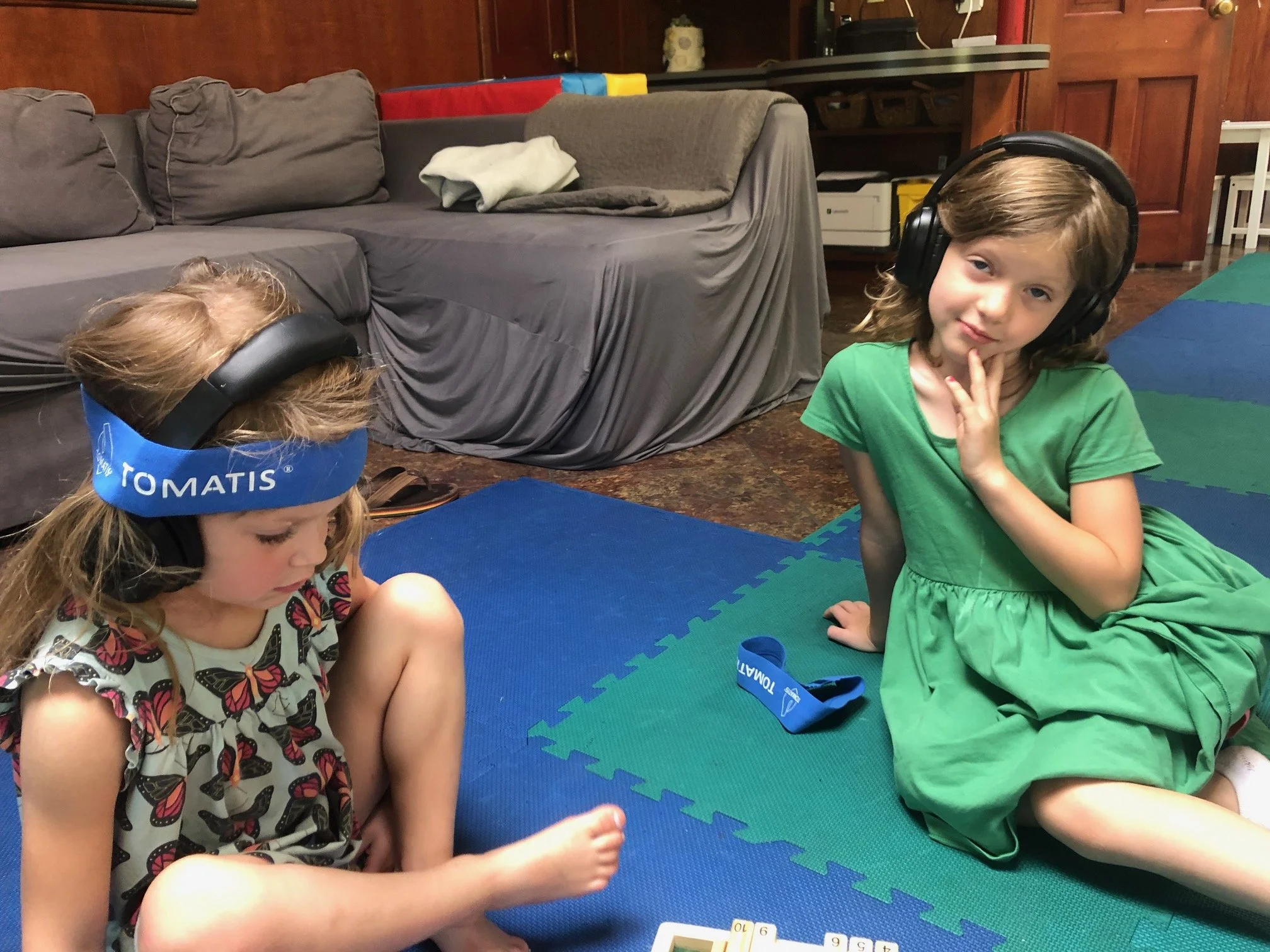
At Growing in Motion, we offer two listening-based approaches: Tomatis® and Therapeutic Listening®. These programs use specially processed sound and music as part of an individualized approach to supporting children's developmental needs.
Our therapists consider each child's strengths, challenges, sensory preferences, and goals when determining whether a listening-based approach may be appropriate. Sound therapy may complement occupational therapy, speech therapy, and other developmental services.
How Can Listening-Based Therapy Support Your Child?
Children experience sound in different ways. Some may be easily distracted by background noise, while others may seek out sound or have difficulty attending to spoken information in busy environments.
Depending on the child's needs and the approach being used, listening-based activities may be incorporated into a broader plan addressing areas such as:
Attention and engagement: Participating in activities and directing attention toward meaningful sounds.
Sensory processing: Exploring responses to auditory input and supporting participation in everyday environments.
Emotional regulation: Supporting individualized strategies for managing sensory experiences and daily demands.
Communication and interaction: Complementing activities that encourage listening, engagement, and connection with others.
Motor skills and coordination: Supporting developmental goals that may involve movement, body awareness, and participation in activities.
Every child is different, and outcomes vary. Listening-based programs are not a replacement for comprehensive evaluation or other indicated therapies.
Tomatis
The Tomatis® Method is a listening-based approach that uses specially processed music and sound. The program incorporates changes in sound frequencies and contrasts, as well as air and bone conduction, according to the Tomatis method's approach to auditory stimulation.
Listening programs are individualized based on the person's needs and the program being used. Some programs also incorporate active activities involving the voice.
At Growing in Motion, Tomatis® may be considered as part of an individualized plan for children experiencing developmental, sensory, attention, or learning challenges.
What makes Tomatis® different?
The Tomatis® Method uses specialized sound-processing technology and a structured listening program. The specific program and listening schedule are determined according to the method's guidelines and the child's individual circumstances. Children who are able to complete a listening test can receive an individualized program according to their needs
Therapeutic Listening
Therapeutic Listening® is a sound-based intervention that uses specially selected and electronically modified music as part of a sensory-based therapeutic approach.
Listening activities are incorporated into a broader plan that considers how a child responds to sensory information and participates in everyday activities. Depending on the child's goals, a therapist may combine listening with movement, play, or other therapeutic activities.
At Growing in Motion, Therapeutic Listening® can complement occupational therapy goals involving sensory processing, attention to activities, body awareness, and participation in daily routines.
What makes Therapeutic Listening® different?
Therapeutic Listening® can be integrated into individualized therapy activities rather than being limited to a standalone listening program. The therapist selects and incorporates listening activities according to the child's needs and the intervention plan.