Sensory Processing Disorder

Sensory processing disorder (SPD) exists when the brain is unable to organize sensory information into appropriate responses (Miller, 2014). Children with SPD experience sensory information differently than other children and may experience sensations more intensely, less intensely, or have difficulty interpreting the difference between sensations which may result in an unexpected response (Miller, 2014 p. 6).
Challenges in Processing and Interpreting Sensations

We all receive information from our eight senses, five external senses as well as three internal or “hidden” senses (Miller, 2014, p. 7): tactile, oral, olfactory, visual, auditory, vestibular, proprioception, and interoception. Children with SPD may have difficulties with processing information from one of more of these senses.
For example, a child with SPD may be challenged with attending in a busy classroom because of difficulty blocking out some of the background noise. Another example would be a child who may take unnecessary safety risks during play.
These difficulties cause disruptions in their everyday life and may appear to be behavioral, emotional, or attentional challenges. They can impact motor abilities, organization, social participation, self-regulation, and self-esteem (Miller, 2014, p. 6). In children with sensory processing disorder, “sensory difficulties are chronic and disrupt their everyday life” (Miller, 2014, p. 17).
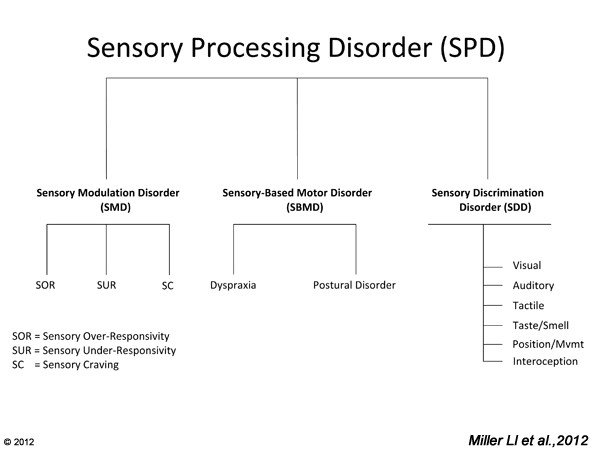
SPD appears in three patterns: Sensory Modulation Disorder (SMD), Sensory Based Motor Disorder (SBMD), and Sensory Discrimination Disorder (SDD). These patterns may occur independently or in combination with each other. Additionally, difficulties may fall along a spectrum with experiences ranging from mild to severe (Miller, 2014, p. 14 and 15).
-
Sensory Modulation Disorder refers to a difficulty turning sensory messages into an appropriate response. The three sub types of Sensory Modulation Disorder (SMD) are sensory over-responsivity, sensory- under responsivity, or sensory craving (Miller, 2014, p. 27).
Sensory over-responsivity: the child responds to sensory messages more intensely, more quickly, and for longer periods of time. You may notice your child covering their eyes or ears because it is too bright or too loud. Children can be over responsive in one sensory system, or in multiple sensory systems (Miller, 2014, p. 28).
Sensory under-responsivity: the child has a lesser response to sensory information, it may take longer for them to respond, and they may require intense or long-lasting sensory information to react (Miller, 2014, p. 31 and 32). Children who are under-responsive often prefer individual activities rather than social activities with peers (Miller, 2014, p. 32).
Sensory craving: these children have an intense craving for sensory experiences and actively seek them out, however obtaining these sensations often dysregulates or disorganizes them (Miller, 2014, p. 34).
-
Sensory Based Motor Disorder refers to difficulty with motor planning movements based on incoming sensory information (Miller, 2014, p. 41).
Dyspraxia: These children may appear to have difficulties with translating sensory information into physical movement which may impact performance in novel movements or movements requiring multiple steps (Miller, 2014, p. 42)
Postural Disorder: Children with postural disorder often present with a weak core or postural stability leading to difficulty with completing novel or familiar motor tasks (Miller, 2014, p. 45)
-
Sensory Discrimination Disorder (SDD) refers to difficulty with interpreting sensory input and determining similarities and difference between input (Miller, 2014, p. 37).
Occupational Therapy Can Help
Occupational therapy can help children with SPD better function in their daily lives by introducing strategies that are unique to the child and their needs. These strategies will be suggested based on what works best for the child and are developed in collaboration with the child, the family, and the occupational therapist to assist with daily occupations such as self-care/grooming, eating, play, and learning to name a few. Occupational therapists may also suggest a “sensory diet” which consists of at-home activities that would be completed as determined by the occupational therapist based on the child’s individual needs. This would be monitored and adapted as needed by the child’s occupational therapist (Sensory Processing Disorder, 2022).
Information was gathered from the following sources:
Miller, L. J. (2014). Sensational Kids: Hope and Help for Children with Sensory Processing Disorder. The Penguin Group.
Sensory Processing Disorder. Psychology Today. (2022). Retrieved January 19, 2022, from https://www.psychologytoday.com/us/basics/sensory-processing-disorder